
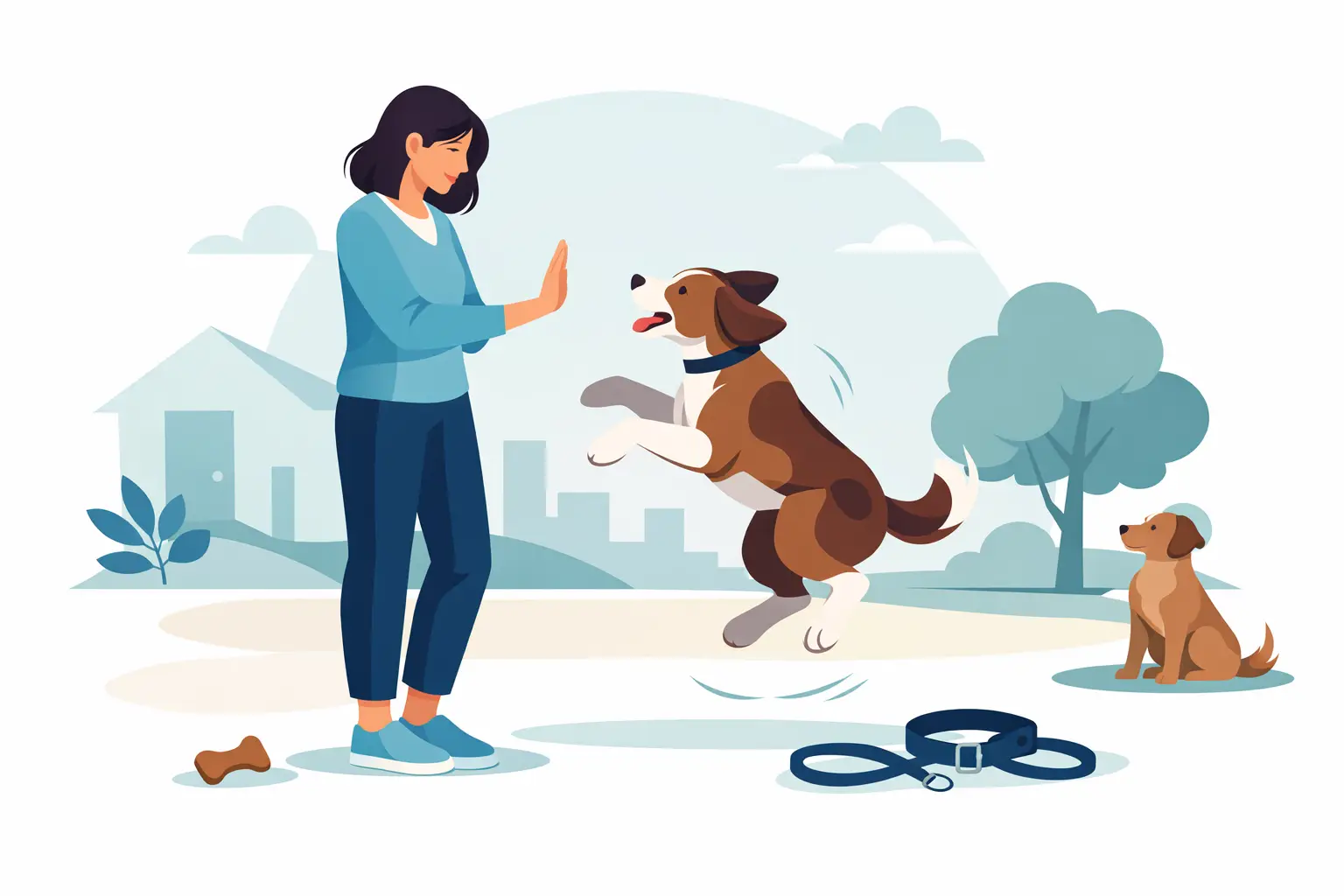
A dog launching at your chest might look friendly to one person and feel overwhelming to another. For families with kids, busy professionals rushing out the door, or anyone welcoming guests into the home, this behavior gets old fast. If you are wondering how to stop dog jumping, the good news is that it is highly trainable when you use a clear system and stay consistent.
Jumping is not usually a sign of dominance or defiance. Most of the time, it works for the dog. Dogs jump because it gets attention, closes distance quickly, releases excitement, or has been accidentally rewarded for months. If your dog jumps and people talk, laugh, touch, or even push him away, the behavior is still paying off.
That is why random corrections rarely solve the problem. To change it, you need to teach your dog what to do instead and make that alternative more rewarding than jumping.
Why dogs jump on people
Dogs greet face-first. Humans stand upright. That mismatch alone explains a lot. Puppies often start by placing paws on legs because they want contact, and owners often respond with petting because it seems harmless when the dog is small. Later, the same behavior becomes a problem when the dog is 50 pounds and greeting grandma at full speed.
Excitement is a major trigger, but it is not the only one. Some dogs jump when owners come home, some jump at visitors, and some jump during walks when they feel frustrated or overstimulated. Rescue dogs may also jump because they have inconsistent greeting histories. One person encouraged it, another punished it, and the dog never learned a dependable rule.
The practical takeaway is simple – the jumping behavior continues because it has a reinforcement history. If you want proven results, you have to change that history.
How to stop dog jumping with a clear plan
The fastest progress comes from treating jumping as a training issue, not a personality flaw. Your dog needs management, repetition, timing, and a replacement behavior.
Start by choosing the behavior you want during greetings. For most dogs, that is four paws on the floor. For higher-energy dogs, a sit is often even better because it gives the dog a specific job. Either option can work, but pick one and keep the rule consistent across the household.
Next, remove the reward for jumping. That means no touching, no eye contact, and no excited talking the moment paws come up. Stand still or turn slightly away. The second your dog has four paws on the floor, mark that moment with calm praise and reward. Timing matters. If you pet while the dog is halfway up, you are still reinforcing the wrong behavior.
Then build repetition in low-distraction situations before expecting success at the front door with guests. A trained dog is a happy dog, and training sticks best when you start where your dog can actually win.
Step 1: Practice calm greetings at home
Begin with people your dog sees every day. Walk up to your dog, and if he remains grounded, reward immediately. If he jumps, withdraw attention. Keep sessions short and controlled. Ten good reps are better than one chaotic greeting.
This is where many owners make the mistake of waiting for real-life moments only. Real life is messy. Training is cleaner. Set up practice when you are not late for work and not carrying groceries.
Use food if your dog is food-motivated, but do not wave treats around wildly. You want calm focus, not more excitement. Hold the reward ready, ask for the behavior you want if needed, then deliver it when the dog succeeds.
Step 2: Teach an incompatible behavior
If your dog has a long jumping history, simply saying no is not enough. Teach a sit, place, or go-to-bed behavior that physically competes with jumping.
A sit works well for greetings in close quarters. A place command works better for doorbells, deliveries, and guests entering the home. The right choice depends on your dog’s energy level and your daily routine. In a small apartment, a stable place behavior can be a game changer because it creates structure in a tight space.
Reward generously at first. Your dog should learn that keeping paws down and staying in position produces attention, food, and access to people.
Step 3: Control the setup before guests arrive
If your dog loses his mind when the door opens, do not wait until the chaos starts to think about training. Put a leash on before guests enter. Use distance. Ask for place or sit before the knock or doorbell if possible.
Management is not cheating. It is smart training. A leash gives you control without wrestling your dog, and it prevents the dog from rehearsing the behavior you are trying to eliminate.
For some dogs, especially adolescents and high-drive breeds, you may need a period of structured greetings only. That means no free-for-all visitor access until the dog has shown consistent improvement.
What people often do that makes jumping worse
Owners are usually more consistent at rewarding jumping than they realize. They pet the dog to calm him down, talk excitedly during greetings, or push the dog off with their hands. From the dog’s point of view, all of that can feel interactive and rewarding.
Another common issue is inconsistency between family members. One person wants a polite dog. Another secretly likes the enthusiastic greeting. Dogs do not generalize rules well when humans keep changing them. If the rule is no jumping, it has to mean no jumping on adults, kids, visitors, and neighbors.
Punishment is another area where timing and judgment matter. Harsh corrections can suppress behavior in the moment, but they often do not teach the dog what to do instead. In some dogs, especially sensitive or anxious dogs, that approach can create confusion around guests and greetings. We prefer motivation-based training because it produces reliable behavior without adding unnecessary stress.
How to stop dog jumping in real-life situations
The front door is one challenge. Coming home is another. Dogs often jump hardest when owners return after an absence because the anticipation has been building.
When you come home, keep your arrival low-key. Do not hype the dog up with loud greetings and frantic petting. Walk in calmly, wait for four paws on the floor or a sit, then reward. If needed, step back outside and re-enter until the dog gets the picture. It may feel repetitive, but repetition is what builds habit.
On walks, jumping often appears when the dog wants attention, gets frustrated, or becomes overstimulated. In that setting, ask for a known behavior such as sit, reward calm engagement, and keep moving. If your dog is too aroused to respond, create distance and reset. Training always works better when the dog is under threshold.
For children, safety comes first. Kids should not be responsible for training an excitable dog alone. Adults need to supervise greetings and set the dog up for success. If your dog jumps on children, use a leash and structured greetings while the dog learns better impulse control.
When jumping is really an impulse control problem
Some dogs are not just greeting poorly. They struggle with self-control in general. They rush doors, grab attention, bark for access, and go from zero to 100 in seconds. In those cases, jumping is one symptom of a bigger pattern.
That is where obedience work helps. Sit, down, place, wait, leash manners, and recall all build the dog’s ability to pause, think, and respond. You do not need a dog that is robotic. You need a dog that can stay calm enough to make good choices.
If your dog is young, this may improve quickly with structure. If your dog is older and has rehearsed jumping for years, progress may take longer. Both dogs can improve. The timeline is just different.
When to get professional help
If your dog is knocking people over, jumping while mouthing, or becoming unmanageable around guests, it is time to get expert guidance. The same is true if you have tried to fix it for months and the behavior keeps returning.
A professional trainer can identify what is actually driving the behavior, tighten up your timing, and build a plan that fits your home. That matters in the real world. A single owner in a condo, a family with toddlers, and a couple with a newly adopted rescue do not need the exact same setup.
At Smart Dogs, we see this often. Owners are frustrated, embarrassed, and tired of apologizing for behavior that feels out of control. The good news is that jumping is usually not complicated once the training becomes consistent, practical, and specific to your dog.
Your dog does not need more chaos at the door or mixed messages from people. He needs a clear pattern: calm behavior gets attention, jumping does not. Stay patient, keep the rules consistent, and give your dog enough practice to succeed. That is how manners become habit, and how your home starts to feel calmer again.
