
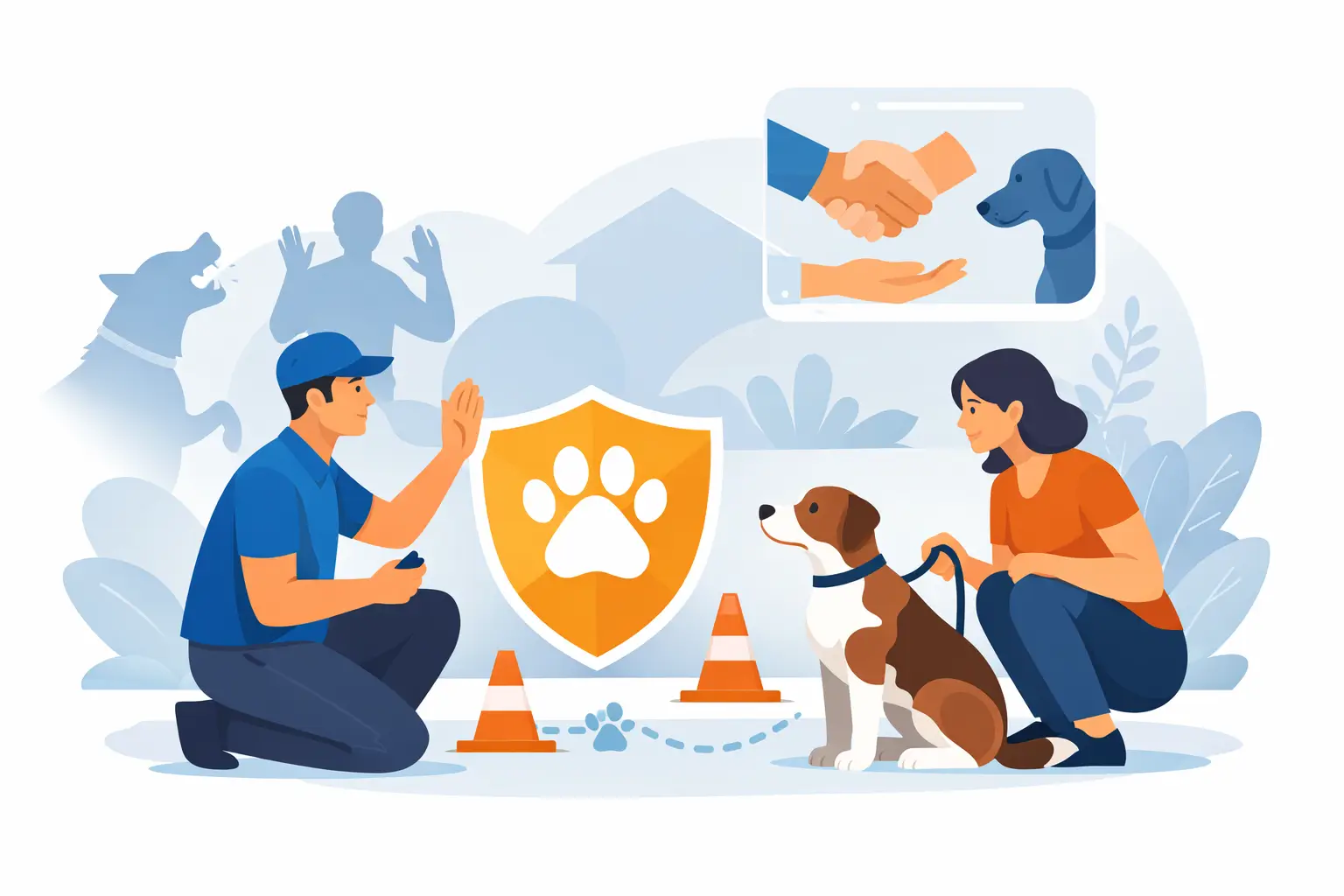
A dog does not bite “out of nowhere.” In most cases, people miss the buildup – the stiff posture, the hard stare, the retreat, the lip lick, the freeze before the reaction. That is why dog bite prevention training matters. It teaches people how to recognize risk earlier, respond better, and avoid the kind of mistakes that turn a manageable moment into an injury.
For dog owners, this is not just about worst-case scenarios. It is about daily life. Kids run through the house. Guests reach for a dog’s face. A delivery worker steps onto the porch. A nervous rescue dog gets cornered in a hallway. Bite prevention starts long before a dog makes contact. It starts with understanding behavior, setting up the environment, and teaching both humans and dogs what to do under stress.
What dog bite prevention training actually teaches
Good dog bite prevention training is not fear-based, and it is not about labeling dogs as aggressive. It is about practical risk reduction. The goal is to help people read canine body language, understand common triggers, and make decisions that lower pressure on the dog.
That includes learning the difference between a relaxed dog and a conflicted one. A wagging tail alone means very little. Loose movement, soft eyes, and easy posture tell a different story than a high, tight tail and a rigid body. Many bites happen because people look for obvious signs like growling and barking, while missing quieter warnings such as freezing, turning away, or showing the whites of the eyes.
This kind of training also covers context. Dogs do not react the same way in every setting. A dog that tolerates petting at home may feel unsafe when approached on leash. A family dog may be gentle with adults but uncomfortable around fast, unpredictable children. A dog recovering from illness, pain, or major routine changes can also have a shorter fuse than usual. Proven results come from treating behavior as situational, not fixed.
Why prevention matters more than reaction
Once a bite happens, the consequences move fast. There may be medical bills, emotional stress, liability concerns, restrictions on the dog, and long-term fear for everyone involved. Prevention is far less costly than trying to repair the fallout.
For owners, prevention protects the dog as much as the people around it. Dogs that bite are often scared, overstimulated, or pushed past their comfort zone. If the people in the home know how to identify early stress and redirect the situation, many incidents can be avoided before the dog feels the need to escalate.
For employees who encounter dogs in the field, prevention is a safety skill. Utility workers, property managers, delivery drivers, home service technicians, and municipal staff often meet dogs on unfamiliar turf. They may have only a few seconds to assess posture, movement, and access points. Training gives them a practical framework so they are not relying on guesswork.
The most common situations that lead to bites
Most bite scenarios are predictable once you know what to look for. Children hugging a dog, grabbing toys, or disturbing a resting dog is a major one. Dogs guarding food, beds, crates, or favorite people is another. So are door greetings, stranger approaches, handling during grooming, and attempts to break up dog-to-dog conflict with bare hands.
Pain is another factor people underestimate. A dog with an ear infection, sore back, dental pain, or orthopedic discomfort may react to normal touch very differently than usual. Rescue dogs and newly adopted dogs can also be at higher risk during adjustment because they are still learning the household, routines, and trust level.
Then there is overstimulation. A dog that is excited, barking, pacing, and losing focus is not in a good state for close handling. Many owners think the problem is disobedience when the real issue is arousal. A trained dog is a happy dog, but training only works when the dog is mentally available to learn.
Dog bite prevention training at home
At home, bite prevention starts with management. That means controlling situations before they become confrontations. Gates, crates, leashes, place commands, and structured routines are not restrictions for the sake of control. They are tools that create predictability.
A dog should not have to guess what happens when guests arrive, when children are playing, or when food is present. Clear patterns reduce stress. If your dog struggles with the front door, do not keep repeating the same chaotic greeting and hope for improvement. Teach a reliable stationing behavior. If your dog guards the couch, stop rehearsing the conflict and change access while training is underway.
Owners also need to change how they interact physically. Avoid crowding, looming over, grabbing collars without preparation, or forcing contact. Let the dog move away. Respecting space is one of the fastest ways to lower tension. Positive reinforcement matters here because it builds trust instead of adding more pressure.
Dog bite prevention training for families with kids
Families need a two-sided plan. You train the dog, and you train the children. Even a very tolerant dog has limits. Kids should be taught not to climb on dogs, chase them, disturb them while eating or sleeping, or put their faces near the dog’s face.
Supervision is not optional. If an adult cannot actively watch the interaction, the dog and child should be separated. That is not punishment. It is smart management. Many family bites happen when adults are nearby but distracted, assuming the dog will simply tolerate whatever the child does.
Dogs also benefit from having protected downtime. A bed, crate, or gated area should mean the dog is off limits. This gives the dog a safe way to disengage instead of feeling trapped. When dogs know they can retreat, they are less likely to use stronger warnings.
Dog bite prevention training for workers in the field
Employees who encounter dogs need skills that are simple enough to use under pressure. They need to know how to approach a property, where to look before opening a gate, how to avoid accidental provocation, and when to stop advancing.
The wrong move is often a small one. Fast entry, direct eye contact, reaching toward the dog, or turning your back while the dog circles can escalate risk quickly. The safer approach is usually slower, more neutral, and more observant. Watch the dog’s body, not just its bark. A barking dog may be bluffing. A quiet, still dog may be much closer to action.
Workers also need realistic expectations. Not every dog can be talked down, and not every situation should be negotiated. Sometimes the safest choice is to create distance, call the owner, or reschedule access. A practical training program makes room for those judgment calls instead of pretending one script fits every dog.
What effective training looks like
Effective bite prevention training is specific, scenario-based, and grounded in real canine behavior. It should cover stress signals, threshold awareness, handling mistakes, environmental setup, and de-escalation strategies. It should also be honest about limits.
Some dogs need basic manners training first because a dog with no impulse control is harder to manage safely. Others need behavior modification around fear, guarding, or reactivity. There is no single fix for every case. It depends on the dog’s history, genetics, training background, health, and household patterns.
That is why experienced guidance matters. With more than 20,000 dogs trained, Smart Dogs has seen the difference between surface-level advice and a proven system that changes daily behavior. The right plan does not just sound good in theory. It works in kitchens, sidewalks, front porches, apartment hallways, and busy family homes.
When to take concerns seriously
If your dog has already snapped, frozen over handling, guarded space, or shown discomfort around kids or strangers, do not wait for a more serious incident. Early intervention gives you more options. The longer a dog practices defensive behavior, the more established it can become.
You should also pay attention if people regularly say your dog is “fine once you get to know him” while the dog shows clear tension around new interactions. That kind of pattern often gets minimized until something goes wrong. A better approach is to treat repeated stress signals as useful information.
The goal is not to make every dog love every person. That is unrealistic. The goal is to create safer routines, clearer communication, and dependable responses so the dog can live successfully within your lifestyle.
Dog bite prevention training works best when it is proactive, not reactive. If you wait until fear, guarding, or overstimulation turns into contact, the stakes are already higher. Start earlier, train clearly, and give your dog the structure to make better choices – because safety at home and in public is built one managed interaction at a time.
