
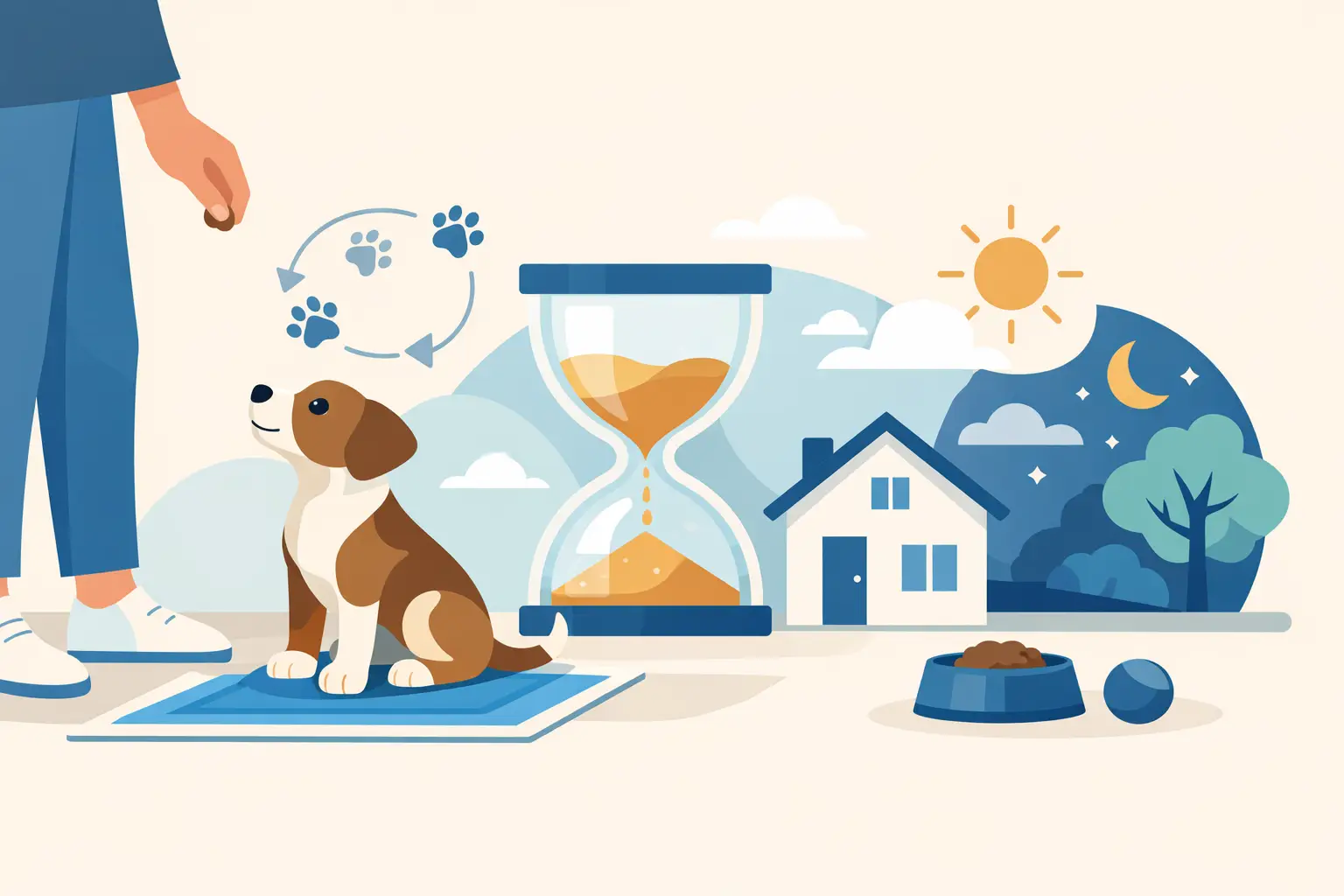
The first week with a new puppy can make anyone question their life choices. You take them out, they sniff the grass, come back inside, and then pee on the rug five minutes later. If you are asking how long does house training take, the honest answer is this: most dogs show solid progress within a few weeks, but full reliability usually takes a few months.
That answer frustrates people because they want a firm deadline. In real life, house training is not a countdown. It is a pattern-building process. Dogs learn faster when the routine is clear, the timing is tight, and the adults in the home are consistent.
How long does house training take for most dogs?
For most puppies, early improvement happens in two to four weeks if the training plan is consistent. Reliable house training often takes four to six months. Some puppies get there sooner. Some take longer, especially toy breeds, very young puppies, rescue dogs with an unknown history, or dogs whose schedule keeps changing.
Adult dogs can sometimes learn faster than puppies because they have better bladder control. But that does not mean every adult rescue will be easy. If a dog has spent weeks in a shelter, lived outdoors, or developed a habit of eliminating indoors, the process can take longer because you are not just teaching a skill. You are changing a routine that already makes sense to the dog.
A good benchmark is this: if your dog is having fewer accidents each week, asking to go out more clearly, and staying clean between scheduled potty trips, training is moving in the right direction.
What changes the timeline?
The biggest factor is age. An eight-week-old puppy simply cannot hold it like a five-month-old puppy can. Very young puppies need frequent trips outside, often after waking, after eating, after play, and every hour or two in between. Expecting long stretches too soon sets both you and the dog up to fail.
Breed and body size matter too. Small dogs often have smaller bladders and faster metabolisms, so they may need more frequent bathroom breaks. That does not mean they are stubborn. It means the schedule has to match the dog in front of you.
Your routine also matters more than most people realize. Busy professionals and families often do well when they create a predictable schedule, but house training slows down when one person takes the dog out every hour and another forgets for three. Dogs learn through repetition. If the pattern keeps changing, progress usually does too.
Environment plays a role as well. Apartment dogs may need more structured trips because they cannot just step into a yard. Dogs living in noisy urban areas may also get distracted outside and forget why they went out in the first place. In Los Angeles especially, it is common to see puppies become so interested in sounds, people, smells, and other dogs that potty time turns into sightseeing.
Then there is owner timing. This is where experienced training makes a real difference. Many accidents happen not because the dog is impossible to train, but because the person misses the window. When a puppy starts circling, wandering off, or suddenly stopping play, you usually have a very short amount of time to act.
How long does house training take when you do it right?
When the process is handled correctly from day one, most dogs learn much faster. That means a clear feeding schedule, regular potty breaks, direct supervision indoors, and immediate reinforcement for going in the right place.
The key word is immediate. If your puppy goes outside and you praise them two minutes later, that is much less effective than praising them the second they finish. Dogs connect outcomes to what just happened, not what happened a while ago.
A crate can help speed up training because it supports bladder control and prevents unsupervised accidents. Used properly, a crate is not punishment. It is management. It helps your dog learn to wait, and it helps you prevent mistakes that would otherwise become habits.
That said, crate training is not magic. If a puppy is left in a crate too long, they may still have an accident, and repeated accidents in the crate can slow progress. The crate works best when it is paired with a realistic potty schedule and active supervision.
Signs your dog is learning
House training does not usually happen all at once. It comes in stages. First, the accidents become less frequent. Then the dog starts eliminating outside more quickly. After that, you may notice your dog heading toward the door, whining, pacing, or looking at you when they need to go.
Eventually, the dog starts holding it longer and staying clean even when life is a little less perfectly managed. That is when owners often relax too soon.
One clean week is encouraging, but it is not the finish line. Reliable house training means your dog can handle a normal daily routine without repeated accidents, not just a few good days.
Why accidents keep happening
If your dog is still having accidents after several weeks, the first question is not, “Why is my dog not getting it?” The better question is, “Where is the system breaking down?”
Inconsistent supervision is a common issue. If a puppy has free access to the house before they are ready, accidents are likely. So is waiting too long between potty breaks. Another common problem is too much freedom after one or two successful days.
Some owners also unintentionally teach their dog to get distracted outdoors. They go outside, the puppy plays, comes back in, and then has an accident. In that case, outside time needs more structure. Take the dog to the same potty area, give them a little time to finish the job, reward immediately, and then offer play.
Medical issues can also affect the timeline. If your dog is urinating very frequently, having accidents despite a good schedule, or seems unable to hold it at a level that should be reasonable for their age, it is worth checking with your veterinarian. Urinary tract infections, digestive upset, and other health concerns can interfere with training.
What helps house training move faster
A proven system always beats guesswork. Feed meals on a schedule instead of free-feeding. Take your dog out first thing in the morning, after meals, after naps, after play, and before bed. Supervise closely indoors, especially during the early weeks.
Reward the exact behavior you want. When your dog eliminates outside, praise calmly and clearly right away. If accidents happen inside, clean them thoroughly and adjust the schedule. Punishing a dog after the fact does not create understanding. It usually creates confusion or sneaky behavior.
Keep expectations realistic. A young puppy is not being defiant when they cannot hold it for long. An adult rescue is not trying to upset you if they do not yet understand the house rules. Training works best when you stay consistent enough that the dog can succeed.
This is where many owners benefit from professional help. At Smart Dogs, we have seen that a clear routine, good timing, and owner follow-through can change the entire pace of housebreaking. A trained dog is a happy dog, and a household with a plan is a calmer place for everyone.
The real answer most owners need
If you want the most practical answer to how long does house training take, think in phases instead of a single deadline. Expect noticeable progress in the first two to four weeks. Expect stronger reliability over the next few months. Expect occasional setbacks during growth, schedule changes, travel, illness, or major household disruptions.
That does not mean training is failing. It means dogs are living creatures, not machines. Progress is rarely perfectly straight.
What matters most is not whether your dog has one random accident next Tuesday. What matters is whether your dog is building the right habit, whether your routine supports that habit, and whether each week looks a little better than the last. Stay consistent, stay observant, and give the process enough time to work. Most dogs can learn this well when the people teaching them are clear, patient, and steady.
