
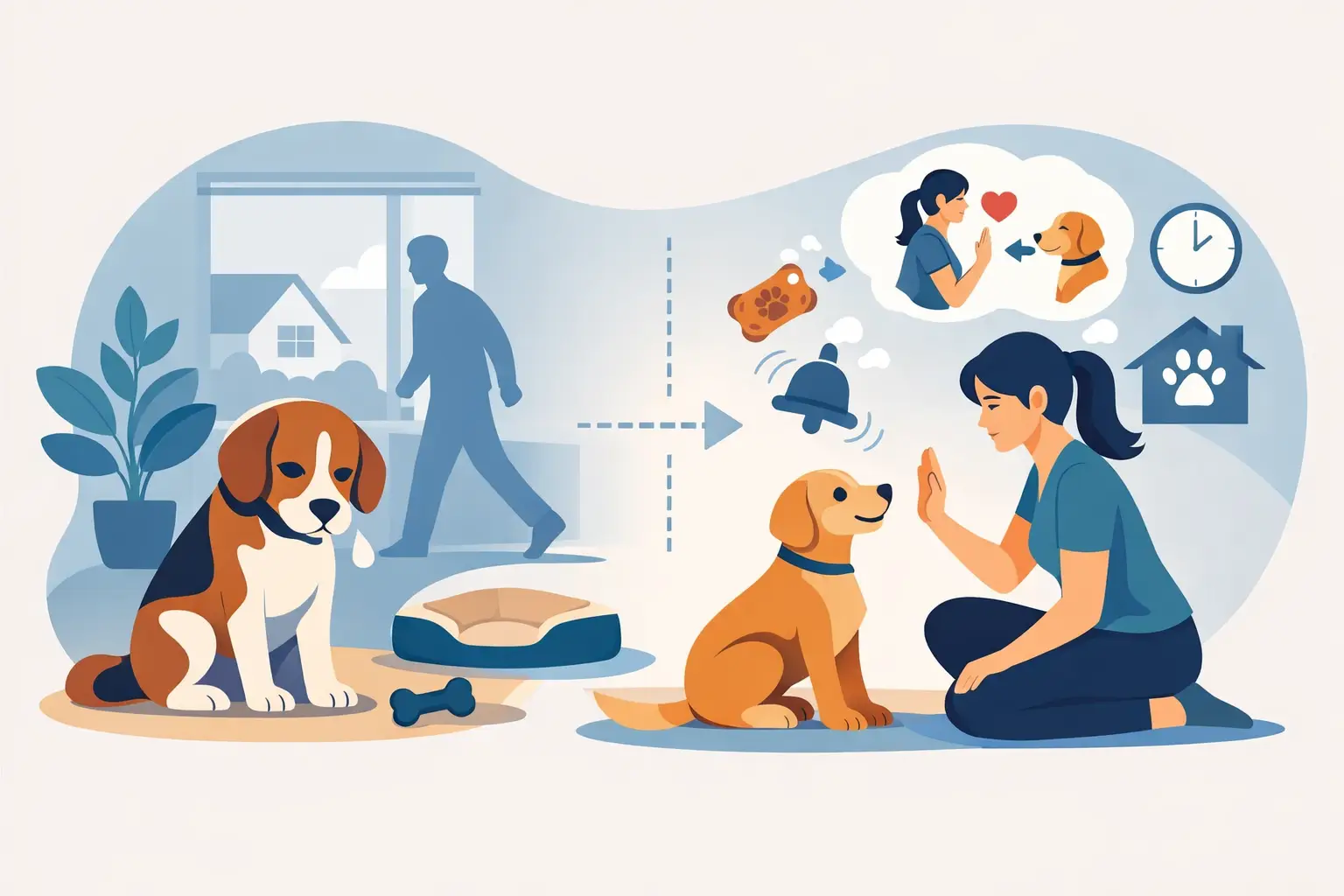
You leave for work, run a quick errand, or step out to pick up the kids, and your dog acts like the world is ending. The barking starts, the pacing ramps up, and you come home to chewed trim, scratched doors, or accidents on the floor. Separation anxiety dog training is not about teaching your dog to “deal with it.” It is about building the skills and confidence your dog does not yet have.
For many owners, this behavior feels personal or dramatic. It is neither. It is stress, and stressed dogs do not learn well unless the training plan is clear, gradual, and consistent. The good news is that this problem can improve. With the right structure, most dogs can learn to stay calmer when left alone.
What separation anxiety really looks like
True separation anxiety is more than a dog who prefers company. A social dog may follow you from room to room or look disappointed when you leave. A dog with separation anxiety shows distress that can be intense and immediate. That distress often includes whining, barking, howling, destructive behavior around exits, drooling, panting, indoor accidents, or frantic attempts to escape.
Timing matters. If your dog settles after a few minutes, you may be dealing with boredom, lack of exercise, or a training gap around household boundaries. If your dog begins to panic as soon as you touch your keys or put on your shoes, that points more strongly to anxiety tied to your departure.
This distinction matters because the solution changes. You cannot exercise your way out of panic alone. Physical activity helps, but it is not a complete separation anxiety dog training plan.
Why dogs develop this problem
There is no single cause. Some dogs are naturally more sensitive. Others struggle after a major change, such as a move, a new work schedule, rehoming, loss of a family member, or a long period of constant companionship followed by sudden alone time. Rescue dogs are not the only ones affected. Puppies, adolescent dogs, and adult dogs from stable homes can all develop separation issues.
Urban and suburban households often make this more noticeable. In Los Angeles, dogs live close to neighbors, apartment walls are thin, and long owner workdays can expose every weakness in a dog’s routine. That means owners need practical progress, not theory. The goal is a dog who can relax in real life, not one who only succeeds in a perfect training setup.
Separation anxiety dog training starts with management
Before you build independence, you need to prevent repeated panic as much as possible. Every full-blown episode can reinforce the pattern. That does not mean you stop living your life forever. It means you become strategic while training is underway.
If your dog melts down during long absences, start by reducing the situations that trigger the worst reactions. Use help from family, a pet sitter, daycare, or a flexible schedule when possible. This is not a crutch. It is management that protects the training process.
You also want to stop accidentally rehearsing your exit cues. Many anxious dogs react before the owner even leaves. Picking up keys, putting on shoes, grabbing a bag, or walking toward the door can all become triggers. Start using those cues at random times without leaving. Pick up your keys, then sit down. Put on your shoes, then make coffee. Open the door, then close it and stay home. Done often enough, these cues lose some of their power.
Build calm before you work on absence
Dogs who cannot settle while you are home usually struggle even more when you leave. That is why independence training begins with calm behavior in your presence.
Teach your dog to relax on a bed or mat while you move around the house. Start close. Reward quiet, settled behavior. Then create small amounts of distance. Walk to the kitchen and return. Step into another room for a second and come back. Increase the challenge in tiny increments so your dog stays successful.
This is where many owners move too fast. A dog can hold a sit-stay for two minutes and still panic when left alone. Obedience helps, but emotional tolerance is the real target. You are not just training position. You are training composure.
Use gradual departures, not big tests
One of the most effective parts of separation anxiety dog training is controlled exposure to being alone. That means very short absences that stay under your dog’s panic threshold.
Begin with departures so small they barely register. Step outside the door for one second, then return. If your dog stays calm, repeat and slowly extend the time. Five seconds becomes ten, then twenty, then thirty. Some dogs progress quickly. Others need several sessions at the same duration before they are ready for more.
The rule is simple: return before the dog escalates. If your dog is barking, scratching, or spiraling, the session was too hard. Go back to an easier level next time. Progress is rarely linear. A dog may handle one minute in the morning and struggle with thirty seconds later in the day. That is normal. Training should respond to the dog in front of you, not to a rigid timeline.
Food can help, but it is not the whole answer
Stuffed food toys, chews, and feeding games are useful tools. They create positive associations with your departure and give the dog something productive to do. For mild cases, that may be enough to shift the emotional picture. For more serious cases, food only helps if the dog is calm enough to eat.
That detail tells you a lot. If your dog ignores a favorite treat the moment you prepare to leave, anxiety is likely too high for distraction alone to work. In those cases, owners often think the dog is being stubborn. Usually, the dog is simply over threshold.
Use food strategically. Offer it during easy practice departures, not only during long absences that already trigger panic. The dog should learn that your exit predicts something good and manageable.
Exercise helps, but tired is not the same as trained
A walk before you leave is a smart move. So is age-appropriate play, training games, and mental work. Dogs with unmet energy needs are harder to settle. But a tired dog can still be an anxious dog.
Think of exercise as support, not the main treatment. A dog who is physically drained but emotionally unprepared may still spend the next hour watching the door, whining, and waiting for you to return. Combine exercise with routine, calm settling practice, and structured departure work for better results.
Common mistakes that slow progress
Owners usually mean well, but a few habits make this issue harder to fix. The first is rushing. Going from ten calm seconds to a twenty-minute errand is usually too big a jump. The second is inconsistency. If one day you train carefully and the next day the dog panics for three hours, progress can stall.
Another mistake is punishing the aftermath. Coming home to damage is frustrating, but correction after the fact does not teach your dog what to do. It can increase anxiety around your return and make the whole pattern worse.
Crate use is another area where it depends. Some dogs feel secure in a crate. Others panic more when confined. If the crate leads to frantic behavior, broken nails, or attempts to escape, it is not the right tool for this problem at that stage.
When to get professional help
If your dog injures himself, destroys doors or windows, cannot stay alone even for a minute, or shows severe distress signals like nonstop vocalizing, heavy drooling, and frantic escape behavior, bring in a professional. This is not a basic obedience issue. It requires a plan built around thresholds, timing, and realistic progression.
An experienced trainer can help you identify whether the behavior is true separation anxiety, isolation distress, barrier frustration, boredom, or a mix of issues. That diagnosis matters. Proven results come from solving the right problem.
In more advanced cases, owners may also need veterinary support. That is not failure. It is sometimes the fastest path to giving the dog enough relief to learn. Good training and medical support can work well together.
What success actually looks like
Success does not always mean your dog becomes completely indifferent to your departure. For many families, success means the dog stays safe, settles faster, barks less, and can handle normal absences without panic. That is a life-changing improvement.
At Smart Dogs, we see the best outcomes when owners stay patient, train in small steps, and focus on what the dog can do today instead of what they wish the dog could do by next week. A trained dog is a happy dog, and in this case, a calmer dog is usually a happier household too.
If your dog struggles when you leave, start small and stay consistent. Calm independence is a skill, and skills can be taught.
